

Best Cool Lamps for Room Corners and Side Tables: 4 Types
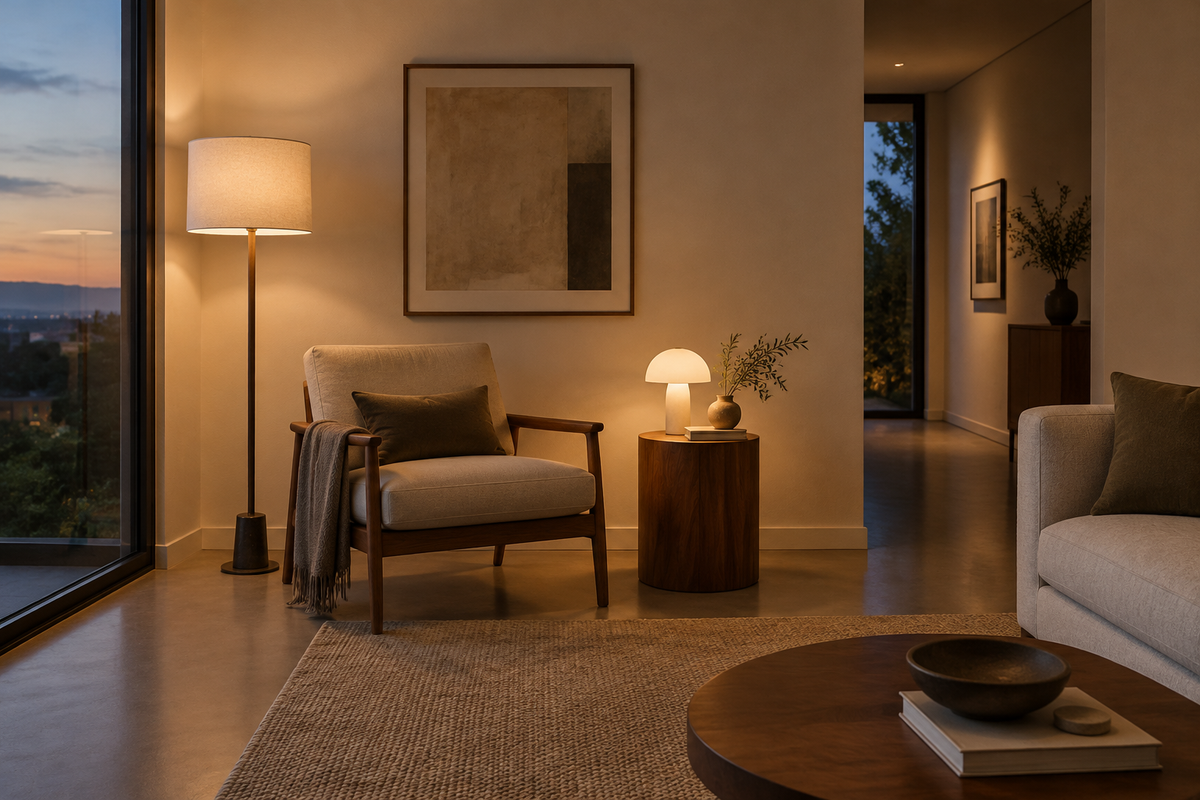
The best cool lamps for room corners and side tables combine a distinctive shape with lighting suited to the space. Choose a slim floor lamp for a corner without furniture, a mushroom lamp for shaded tabletop light, a cordless globe for placement away from outlets, or an adjustable task lamp for reading.These four recommendations compare lamp types by placement and function, rather than claiming a tested product ranking. Here, "cool" refers to design, not a cool-white light color.Compare the 4 Lamp Types Lamp type Most useful placement Main advantage Check before buying Slim floor lamp Empty corner beside seating Adds light without occupying a tabletop Base footprint, shade clearance, and cord route Mushroom table lamp Side table or nightstand Combines a rounded silhouette with shaded light Shade width and visible bulb glare Cordless globe lamp Side table away from an outlet Provides movable ambient light without a trailing power cord during use Brightness, runtime, and charging requirements Adjustable task lamp Side table next to a reading chair Directs light toward a book or other task Arm reach, stability, and adjustment range 1. Slim Floor Lamps for Empty Room CornersA slim floor lamp is a practical choice when a corner needs light but has no side table. Its vertical form leaves the tabletop free, although the base still needs enough floor space to sit securely outside a walking route.Choose a shaded model when you want light around a chair, or an uplight when you want light reflected from the ceiling. An uplight's effect depends on ceiling height, surface color, and output; it should not automatically be treated as a reading light. Useful features: Dimming, an accessible switch, and a stable base. Placement check: Allow clearance between the shade, walls, curtains, and furniture according to the manufacturer's instructions. Limitation: A narrow stem does not necessarily mean a small base. 2. Mushroom Table Lamps for Shaded Side-Table LightMushroom lamps have a broad, rounded shade above a shorter stem or base. Their recognizable profile makes them useful when you want a decorative shape that remains noticeable while the lamp is switched off.Light distribution varies by construction. An opaque dome generally directs more light downward, while a translucent shade can also glow across its surface. Check the lamp from seated eye level because an exposed bulb beneath the shade can cause glare. Useful features: Dimming and a shade that conceals the light source from normal viewing positions. Placement check: Measure the widest part of the shade, not just the base. Limitation: A low decorative lamp may not direct enough light onto a book. 3. Cordless Globe Lamps for Tables Away From OutletsA cordless globe lamp suits a side table where a power cable would cross an open floor or interrupt a seating arrangement. Its rounded diffuser can provide ambient light, but cordless operation alone does not establish whether it is bright enough for reading.The Moon Cordless LED Dimmable Table Lamp is a relevant example: it uses a rechargeable orb design with adjustable ambient light. Those features make it worth considering for movable accent lighting rather than assuming it replaces a task lamp. Useful features: Adjustable brightness, accessible charging, and a clear battery indicator. Placement check: Plan where the lamp will recharge and whether it can operate while charging. Limitation: Battery runtime can vary with brightness; compare the conditions behind stated runtime figures. 4. Adjustable Task Lamps for Reading Beside a ChairAn adjustable task lamp is the most suitable of these four types when directing light onto a page is the priority. A pivoting head or articulated arm lets you position the light without moving the entire table.Choose the lamp's reach around your seating arrangement, not its appearance alone. The head should illuminate the reading area without putting the light source directly in your eyes, and the base should remain stable throughout its intended adjustment range. Useful features: A shielded light source, easy-to-reach controls, and secure adjustment joints. Placement check: Confirm that the arm can reach the book without extending into a walkway. Limitation: A focused beam may leave the surrounding corner dark, so separate ambient lighting may still be useful. How to Choose the Right Lamp Size and Light Start with the available space and the job the lamp must perform. A lamp that fits physically can still be unsuitable if its shade blocks your view, its switch is difficult to reach, or its light misses the reading area. Measure the full footprint: Check base dimensions, shade diameter, total height, and any arm extension. Leave usable table space for everyday objects. Check glare while seated: For many shaded table lamps, keeping the bulb concealed behind the shade is a useful starting point. Your chair height and posture determine the final position. Compare lumens, not watts: Lumens describe light output; watts describe power consumption. Reading performance also depends on distance, beam direction, and diffusion. Separate color from brightness: Around 2700-3000 K gives a warm-white appearance. A warmer color temperature does not necessarily mean a dimmer lamp. Verify dimming compatibility: For replaceable bulbs, the bulb and dimmer must be compatible. For integrated LEDs, check the specified controls. Check maintenance: Confirm whether the bulb, battery, or LED module is replaceable before purchasing. Frequently Asked QuestionsCan a table lamp light an entire room corner?A table lamp can provide ambient light in a corner, but coverage depends on output, shade design, placement, and nearby surfaces. A small decorative lamp should not be assumed to provide sufficient reading light.How do you size a lamp for a small side table?Measure the lamp's base and widest shade dimension against the available tabletop. Keep the base fully supported and leave room for everyday objects, switch access, and a safe cable route.Are cordless lamps suitable for reading?Some cordless lamps are suitable for reading, but battery power alone tells you nothing about task-light performance. Check light output, beam direction, glare control, and runtime at the brightness you intend to use.What color temperature works for evening ambient lighting?Warm-white light around 2700-3000 K is a common choice for evening ambient lighting. Color temperature describes the light's appearance, while brightness depends on output and dimming.
7 Interesting Lighting Fixtures That Become Conversation Pieces
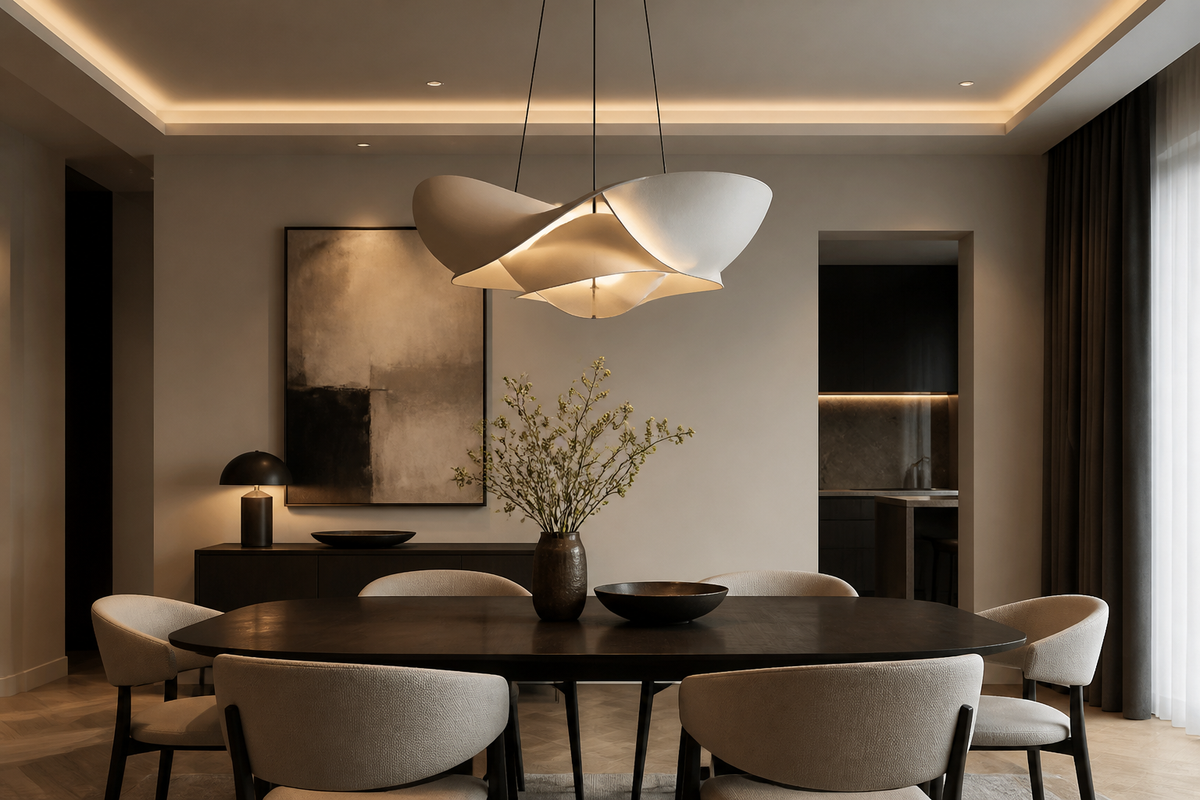
Interesting lighting fixtures do more than brighten a room. They create a focal point, define the mood, and often become the detail people notice first. The most effective conversation-piece lighting combines a clear visual idea with the right scale, placement, and light quality.This list focuses on fixture types that stand out in a practical way. Instead of relying on novelty alone, these designs use shape, material, contrast, or mobility to make a room more memorable.1. Sculptural pendant lights Sculptural pendants work because they are visible from multiple angles and naturally occupy the center of a room. Curved ceramic shades, layered forms, pleated silhouettes, and asymmetrical compositions can all read as functional decor rather than just overhead lighting.In dining rooms, kitchens, and entryways, a pendant with a strong profile can anchor the entire layout. A piece such as the Pleated Ceramic & Brass Cocoon Pendant Light is a useful example because its pleated ceramic form and brass detailing add texture and contrast without requiring excessive ornament.2. Soft-color pendant fixturesColor can make a fixture memorable even when the silhouette is simple. Pastel, muted earth tones, and low-sheen finishes tend to create a design-led look that stands apart from standard black, white, or chrome lighting.This approach works especially well when the room already has quiet finishes and needs one controlled accent. The Soft Pastel Pendant Light fits this idea with its wood-and-metal construction, multiple sizes, and dimmable design, which makes it easier to balance visual impact with everyday usability.3. Cordless table lamps with unusual formsA conversation piece does not have to be hardwired or oversized. Cordless lamps often attract attention because they appear in places where people do not expect a light source, such as a bookshelf, bar cart, patio table, or entry console.Orb and globe forms are especially effective because they read as both lighting and object. The Moon Cordless LED Dimmable Table Lamp uses a rechargeable cordless design and adjustable ambient light, which makes it practical for indoor and outdoor settings while still feeling distinctive enough to spark questions from guests.4. Wall-mounted fixtures that look integrated into the roomInteresting wall lighting often becomes a conversation point because it changes how people read the architecture. A fixture mounted along stairs, in hallways, or beside a bed can feel more intentional than a generic ceiling light, especially when the design is compact and material-driven.Wireless wall lighting also gets noticed because people often assume it requires concealed wiring. The Ultra USB Motion Sensor Rechargeable Wall Light is notable for that reason: it combines a wood-accented look with rechargeable, cable-free operation and motion sensing, which makes the fixture itself part of the conversation.5. Oversized fixtures in small roomsScale is one of the simplest ways to make lighting memorable. In a compact room, a slightly oversized pendant or chandelier can create tension in a good way, provided there is still physical clearance and the fixture does not overwhelm circulation.This strategy works best when the rest of the room is edited and the fixture has one strong idea, such as a layered shade, an elongated form, or a dramatic material contrast. Too many competing focal points can weaken the effect.6. Material-mix fixturesFixtures that combine two or more materials often feel more custom and more noticeable than single-finish designs. Ceramic and brass, wood and metal, or frosted glass with dark hardware can create enough visual complexity to hold attention even when the shape is restrained.Material contrast is especially useful in modern interiors, where form is often simple. It adds depth without relying on excess decoration, and it helps a fixture connect with other finishes already present in the room.7. Portable accent lighting used away from the usual spotsOne of the easiest ways to create a talking point is to use lighting in an unexpected location. A rechargeable lamp on an outdoor dining table, a hallway pedestal, or an open shelf can make the room feel more considered because the light source appears intentionally placed rather than permanently fixed.This is also why portable fixtures are useful in layered lighting plans. They can provide mood lighting, highlight an object, and create a focal moment without renovation.How to choose a fixture that gets noticed for the right reason Prioritize one defining featureThe best conversation-piece lighting usually has one dominant characteristic: shape, scale, color, material, or placement. If a fixture tries to do all of these at once, it can look busy instead of deliberate.Match the fixture to viewing distanceLarge, sculptural lights are most effective where people can see them from across the room or from multiple sightlines. Smaller but unusual pieces work better in closer, slower spaces such as beside seating, near a bed, or along a corridor.Check light quality as well as appearanceA fixture that looks dramatic but casts harsh light will not work well over time. Dimmable designs and diffused shades are often better choices for statement fixtures because they preserve atmosphere while still drawing attention.Use surrounding decor to support the lightStatement lighting is easier to read when nearby surfaces and furnishings are relatively calm. If the room already contains strong patterns, bold art, and high-contrast finishes, a simpler fixture may actually stand out more effectively.Where conversation-piece lighting works best Dining rooms: central pendants and chandeliers naturally command attention above the table. Entryways: a distinctive overhead fixture creates an immediate first impression. Living rooms: sculptural floor, table, or ceiling lighting can act as a visual anchor. Bedrooms: unexpected bedside or wall lighting adds character without crowding the room. Covered outdoor areas: portable lamps can create atmosphere and visual interest without permanent installation. For broader browsing of modern statement options, the Design Lighting page is relevant because it groups decorative lighting for multiple room types in one place.FAQWhat makes a lighting fixture a conversation piece?A conversation-piece fixture has a visual quality that people notice quickly, such as an unusual shape, distinctive material mix, unexpected placement, or strong scale relative to the room.Do statement light fixtures need to be large?No. Size can help, but smaller fixtures can also stand out if they use a memorable form, color, texture, or placement.Where should a statement light be placed?The most effective locations are areas with clear sightlines and regular use, such as dining rooms, entryways, living rooms, and bedside zones.Can portable lamps become a design focal point?Yes. Portable cordless lamps often become focal points when they are placed in unexpected locations or when the lamp itself has a sculptural silhouette.Should the rest of the room be simple if the fixture is bold?Usually, yes. A calmer background helps the fixture remain the focal point and prevents the space from feeling visually crowded.
How to Decorate With Table Lamp Decor: Practical Styling Rules
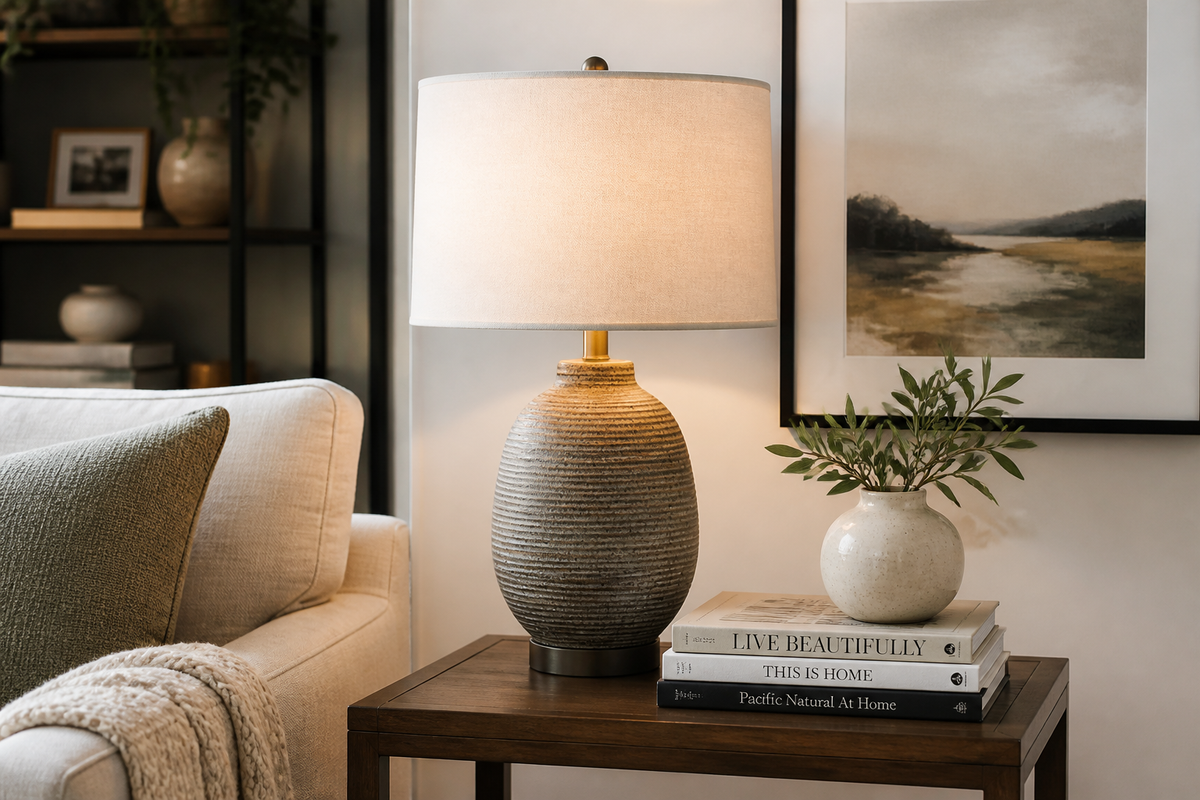
Table lamp decor works best when the lamp does two jobs at once: it provides useful light and helps the surface look finished. The most effective setups usually rely on proportion, height, and a small group of nearby objects rather than many decorative items. If you start with function first, the decorating choices become easier.Use a table lamp to anchor a nightstand, side table, console, desk, or buffet. Then style around it with a limited mix of objects that vary in height, shape, and texture. This approach keeps the lamp from looking isolated or oversized.Choose the Right Table Lamp for the Surface and the Room The lamp should fit the scale of the furniture underneath it. A large, heavy lamp can overwhelm a narrow table, while a very small lamp can look visually lost on a wide console or buffet. Shade width matters too, because the shade often creates more visual volume than the base.For practical use, the bottom of the shade should usually sit near eye level when you are seated beside it. That helps reduce glare and directs light where you need it. In bedrooms, this is especially important for reading and nighttime use.If you need flexible placement, a cordless option can help on surfaces where outlets are inconvenient. For example, the Moon Cordless LED Dimmable Table Lamp is described as a rechargeable orb lamp for indoor and outdoor spaces with adjustable ambient light, 8 to 10 hours of continuous use, and USB recharging in about 2 hours.Quick size guidance Use compact lamps on small nightstands, narrow shelves, or petite side tables. Use medium lamps on standard end tables, desks, and dressers. Use larger lamps on wide consoles, buffets, or substantial living room tables. Style the Area Around the Lamp A table lamp usually looks better when it is part of a small composition instead of standing alone. The easiest method is to pair it with one or two lower objects, such as books, a tray, a candle, or a small vase. This creates a visual transition from the lamp down to the table surface.Keep the arrangement simple. If the lamp base has texture, color, or a sculptural shape, surrounding decor should stay restrained. If the lamp is minimal, you can add more character with accessories.A simple styling formula Place the lamp first and decide its exact function. Add one horizontal element, such as a book stack or tray. Add one smaller accent, such as a bowl, branch, or vase. Leave some empty space so the surface does not feel crowded. On a desk, one decorative object is often enough. On a console or buffet, a lamp may sit beside framed art, a mirror, or a taller branch arrangement. If you want a second decorative accent for a styled tabletop, a small object such as the Milo Ceramic Desk Clock can work because it is described as a refined decorative accent for desks, bedside tables, and shelves.Use Table Lamps Differently in Each Room Table lamp decor should change based on how the room is used. The right arrangement in a bedroom is not always right for an entry, living room, or patio table. Start with the main task in the space, then style the lamp to support it.BedroomOn nightstands, table lamps need comfortable reading height and enough clearance for daily essentials. Keep the styling minimal so the surface remains useful. If you need more layered lighting near the bed, supplemental wall lighting can reduce clutter on small tables.For compact bedrooms or tight nightstands, wall-mounted lighting can free up surface space. The Ultra USB Motion Sensor Rechargeable Wall Light is described for bedrooms, hallways, closets, and other areas where wireless, battery-powered lighting is useful.Living roomOn side tables, lamps help define seating zones and make the room feel warmer in the evening. Pair the lamp with a coaster, book, or small tray rather than filling the whole surface. On consoles, lamps often work best as framing elements placed near the ends.Dining area or entryA table lamp can soften a buffet, sideboard, or entry console by adding low, ambient light. This is useful when overhead fixtures feel too bright for everyday use. If the room also needs ceiling lighting for general illumination, a coordinated overhead fixture can help balance the overall scheme.For rooms where you want a softer overhead layer, Soft Pastel Pendant Light and Pleated Ceramic & Brass Cocoon Pendant Light are both listed as pendant options suited to dining rooms, kitchens, or design-led interiors.Outdoor or flexible-use spacesPortable lamps are useful on covered patios, dining tables, and shelves where cords would get in the way. The goal is not to recreate bright task lighting outdoors, but to add a contained pool of light that supports conversation and atmosphere. A cordless lamp is often easier to move and restyle as needed.Balance the Lamp With Other LightingA table lamp should be one layer in the room, not the only source of light. Most rooms work better when lighting is layered across ambient, task, and accent functions. This reduces harsh contrast and makes the lamp feel integrated into the room rather than decorative only.If the room feels too dim with one lamp, add a second lamp on another surface or combine it with ceiling or wall lighting. If the room feels visually busy, simplify by choosing fewer fixtures with clearer roles. A useful starting point for broader room planning is Design Lighting, which is presented as a collection of decorative and modern lighting fixtures for different spaces.Common Mistakes to Avoid Using the wrong height: A lamp that is too tall creates glare, and one that is too short may not provide useful light. Ignoring scale: The lamp, shade, and table should look proportionate together. Overdecorating the surface: Too many accessories make the lamp area look crowded and less functional. Relying on one light source: Rooms usually need layered lighting, not a single lamp. Choosing decor before function: Start with where light is needed, then style the surface around that choice. FAQWhat should I place next to a table lamp?Place one or two smaller items next to a table lamp, such as a tray, book stack, vase, or candle. The goal is to create balance without overcrowding the surface.How tall should a table lamp be?A table lamp should usually place the bottom of the shade close to eye level when you are seated nearby. This helps reduce glare and makes the light more comfortable to use.Can a table lamp be used as decor only?Yes, but it usually looks better when it still contributes usable light. Even decorative lamps work best when they support ambient or task lighting in the room.Should table lamps match in a room?They do not need to match exactly. They should relate through scale, finish, color, or shape so the room feels coordinated rather than repetitive.
Best Outdoor Lamps for Patios, Porches, and Balconies: 6 Types Compared
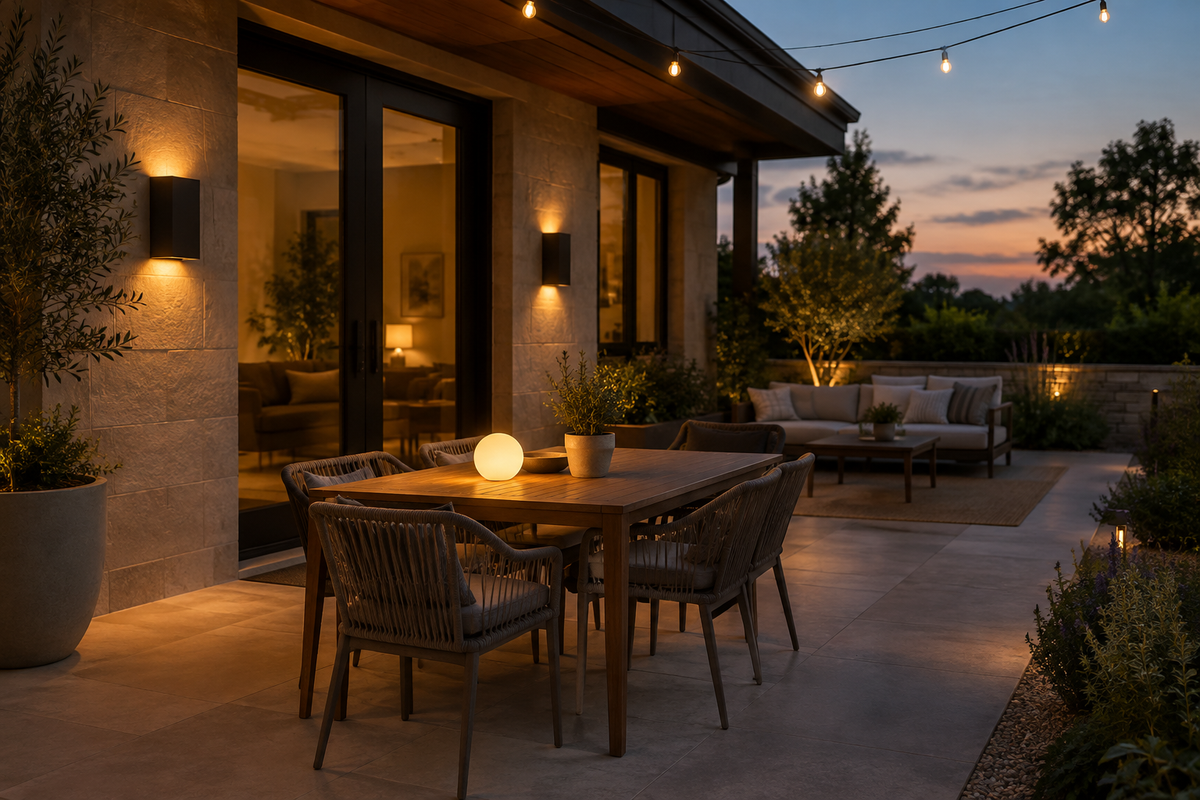
The best outdoor lamps depend on where you need light: cordless table lamps suit dining tables and small balconies, wall sconces suit porch entrances, and outdoor floor lamps suit larger seating areas. Lanterns, ceiling fixtures, and string lights serve different needs, from portable accent lighting to broader illumination.Choose the weather rating before the shape or finish. This list compares six lighting types by use case rather than ranking specific products or claiming hands-on testing.Outdoor Lamp Types Compared Lighting type Best application Main advantage Main limitation Cordless table lamp Patio dining and small balconies Places light directly on the table without a power cord Requires recharging and verified outdoor suitability Portable lantern Flexible accent lighting Moves between seating areas Decorative models may not provide useful task light Wall sconce Porch entrances and narrow balconies Keeps tables and floors clear Usually requires permanent mounting and wiring Ceiling fixture Roofed porches and covered patios Provides overhead illumination Requires a suitable mounting location Outdoor floor lamp Larger patio seating areas Brings light closer to chairs Needs floor space and a stable base String lights Ambient lighting over patios and balconies Distributes small light sources across an area Does not replace dedicated task or entrance lighting 1. Cordless Table Lamps: Best for Dining Tables and Small Balconies A cordless table lamp provides localized light without routing a cable across the floor. It is a practical choice for renters, movable furniture, and balconies where an outlet is inconvenient.Look for dimming, a stable base, and a diffuser or shade that limits glare at seated eye level. Check runtime at the brightness you expect to use; a maximum-runtime claim may refer to a lower setting.The Moon Cordless LED Dimmable Table Lamp is a rechargeable globe lamp described for indoor and outdoor ambient lighting. Its published description does not establish a specific weather rating, so confirm permitted exposure before using it where rain or spray can reach it. 2. Portable Lanterns: Best for Flexible Accent LightingA battery-powered LED lantern works when you want to move light between a dining table, side table, and seating area. A handle simplifies carrying, while a broad base helps keep it upright.Choose a diffused light source for nearby seating rather than an exposed, high-brightness LED. Keep lanterns off steps and walking routes, even when they are cordless.Solar lanterns can reduce charging tasks where their panels receive sufficient daylight. Their output and operating time depend on sunlight, season, shading, and battery condition, so they should not be the only light for an entrance or stairs.3. Wall Sconces: Best for Porch Entrances and Narrow SpacesExterior wall sconces illuminate a doorway without occupying floor or tabletop space. Shielded designs can direct light toward the threshold while reducing glare toward seating or neighboring windows.Choose fixtures approved for the actual exposure, including wind-driven rain. A roof does not automatically make every position suitable for a damp-location fixture.Motion sensing can help at entrances, while dusk-to-dawn controls automate evening operation. For hardwired fixtures, use a qualified electrician and follow local electrical requirements.4. Ceiling Fixtures: Best for Covered PorchesA flush-mount ceiling light provides overhead illumination without the hanging height of a pendant. It is useful on covered porches with limited headroom or doors that could interfere with a suspended fixture.A pendant can suit a taller roof over a fixed dining table, provided its clearance and installation meet the manufacturer's instructions. Both fixture types need an appropriate outdoor location rating; an indoor pendant does not become outdoor-safe simply because it sits beneath a roof.5. Outdoor Floor Lamps: Best for Larger Seating AreasAn outdoor floor lamp places light near a lounge chair or sofa without requiring a nearby side table. For reading, choose a model that directs enough light onto the page rather than relying only on a decorative glowing shade.Check the base dimensions, stability, and manufacturer's wind and storage guidance. Route any outdoor-rated power cord away from walking paths, and do not assume a heavy base makes a lamp safe in strong wind.6. String Lights: Best for Broad Ambient LightingOutdoor string lights distribute light across a patio or balcony without taking up furniture space. They work as background lighting above a dining or seating area, particularly when paired with a table lamp or entrance fixture.Use outdoor-rated sets and compatible supports, following the manufacturer's spacing, connection, and maximum-run instructions. Check rental rules before attaching hooks, and do not suspend strings from electrical wiring or unsupported improvised mounts.What to Check Before Buying an Outdoor LampCompare safety and usable light before decorative details. These checks help distinguish a suitable outdoor fixture from an indoor lamp that only looks appropriate outside. Location approval: Damp-location fixtures are intended for protected moisture exposure, not direct rain. Wet-location fixtures are intended for exposure to water under their stated installation conditions. IP rating: IP44 indicates protection against splashing water; IP65 indicates dust-tight construction and protection against water jets. Neither rating permits submersion, and an IP rating alone does not establish compliance with local electrical requirements. Brightness: Compare lumens rather than watts. Required output varies with mounting height, beam spread, surface colors, and whether you need dining, reading, or circulation light. Color temperature: Around 2700K to 3000K provides warm-white light commonly used around residential seating. Color temperature describes appearance, not brightness. Glare control: Favor shaded or diffused light sources near eye level. More light is not helpful if the source shines directly into your eyes. Power and charging: Check battery runtime, charging instructions, outlet access, and any transformer requirements. Keep chargers dry unless explicitly rated for the intended exposure. Electrical protection: Use outdoor-rated electrical components and GFCI protection where required. A weather-resistant lamp does not make an indoor extension cord suitable outside. Frequently Asked QuestionsWhat is the best type of light for an outdoor patio?A cordless table lamp suits dining, while an outdoor floor lamp can serve a seating area. Add wall, ceiling, or string lighting when the space also needs broader illumination, and match every fixture to its weather exposure.What kind of light is best for a front porch?Exterior wall sconces or an outdoor-rated ceiling fixture can illuminate a front porch entrance. Choose a shielded design that lights the threshold without directing glare toward approaching visitors.What outdoor lights work on a small balcony?A compact cordless table lamp saves floor space and avoids trailing power cords. Where mounting is permitted, a wall fixture can keep both the floor and tabletop clear.Can cordless outdoor lamps stay outside in the rain?Only leave a cordless lamp exposed to rain when its manufacturer explicitly permits that use. Battery power does not establish water resistance; check the location rating, charging-port protection, and storage instructions.
How to Choose a Modern LED Lamp for a Minimalist Space
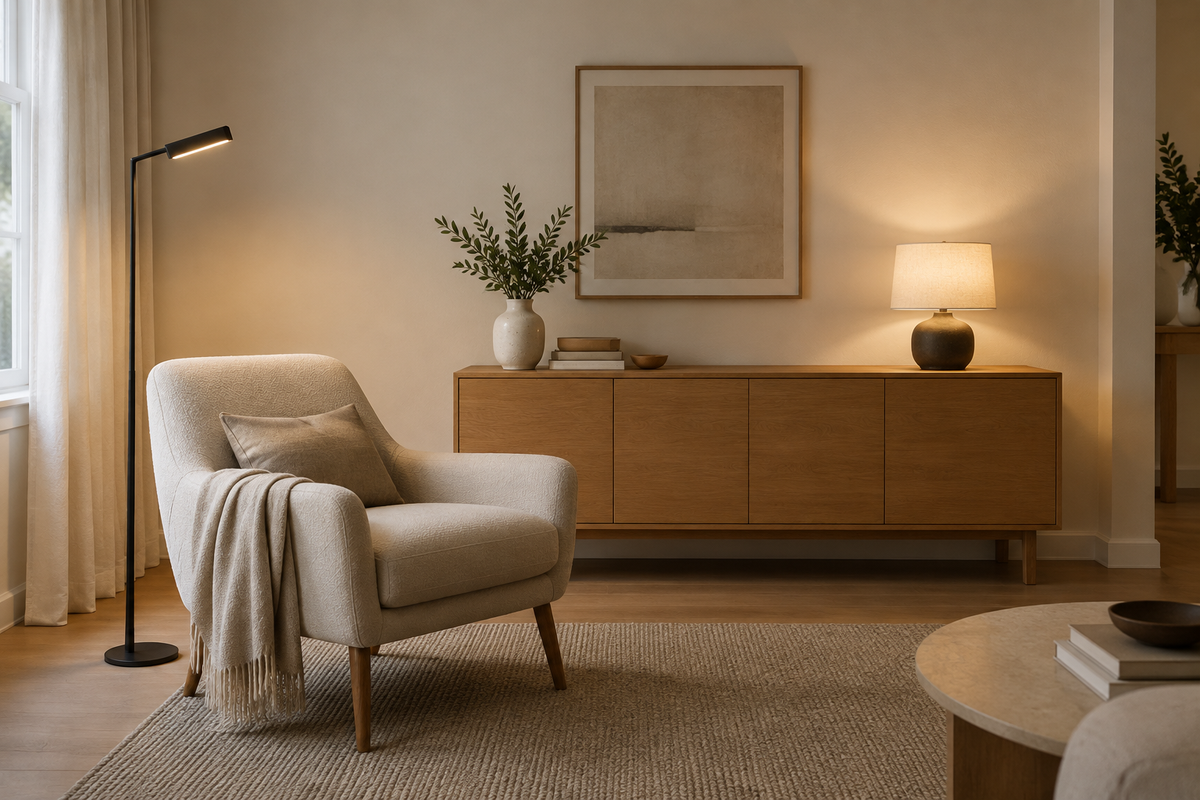
Choose a modern LED lamp by matching its light output and beam direction to a specific task, then checking its size, glare control, and power requirements. For a minimalist space, favor a clear silhouette, a restrained finish, and controls that provide useful adjustment without adding clutter.Appearance alone does not determine whether a lamp will work. A slim fixture can still produce uncomfortable glare, while a compact decorative lamp may not provide enough light for reading.Match the lamp type to its main jobDecide whether the lamp needs to illuminate a task, provide background light, or highlight an object. This choice determines the shade, light direction, and placement more reliably than the label "modern" or "minimalist." Lamp type Useful application What to check Adjustable desk or reading lamp Reading, writing, and focused work Head adjustment, reach, shielding, and light coverage Shaded table lamp Bedside lighting and softer background illumination Shade diameter, base stability, and access to controls Slim floor lamp Lighting a seating area without occupying tabletop space Base footprint, head position, and clearance beside furniture Cordless table lamp Portable accent light where an outlet is inconvenient Brightness, runtime at the intended setting, and charging requirements In a small room, choose the type that preserves the surface or floor area you need most. A floor lamp saves tabletop space but still requires a stable base; a compact table lamp keeps the floor clear but occupies part of a desk or nightstand.Do not expect one small accent lamp to provide both comfortable reading light and complete room illumination. A task lamp can supplement existing ambient lighting without requiring several decorative fixtures.Compare brightness, color temperature, and dimmingRead the lighting specifications before comparing finishes. Lumens describe light output, watts describe electrical power consumption, and kelvin describes the appearance of white light. Specification Practical selection guidance Important limitation Brightness in lumens As a starting point, consider roughly 250-500 lumens for a supplementary ambient lamp or 450-800 lumens for a reading lamp. These are shopping ranges, not room-lighting requirements. Distance, beam spread, shades, and individual needs change the result. Color temperature in kelvin Consider 2700-3000 K for warm residential lighting and 3500-4000 K when a more neutral appearance suits the task. A higher color temperature does not necessarily mean higher brightness. Color rendering index, or CRI Look for CRI 90 or higher when accurate rendering of artwork, textiles, or finishes matters. CRI does not describe brightness, glare, or every aspect of color quality. Dimming Check the adjustment range, control method, and compatibility requirements. A dimmable LED bulb does not guarantee compatibility with every dimmer. Judge usable light, not just the lumen numberA directional lamp concentrates light on a smaller area, while a diffused lamp spreads it more broadly. Two lamps with the same lumen output can therefore illuminate a book very differently.For integrated LED fixtures, check whether the stated output refers to the complete fixture or only the LED source. For lamps with replaceable bulbs, remember that the shade and diffuser affect how much light reaches the room.Choose controls that suit daily useFor a bedside lamp, low-level dimming and an easily reached switch may matter more than a high maximum output. For a desk lamp, an adjustable head and straightforward brightness controls can be more useful than decorative lighting modes.If flicker information is available, check performance across the dimming range rather than relying only on a general product claim. Visible flicker, buzzing, or unstable low settings are reasons to reconsider the lamp and dimmer combination.Check scale, placement, and glare Measure the entire lamp, not just its base. Shade width, arm reach, and the position of the light source determine whether it fits beside furniture and illuminates the intended area. For a table lamp: Check that the base sits fully on the surface and the shade does not interfere with nearby shelves or normal movement. For a floor lamp: Measure the base footprint and any arm that extends over a chair, sofa, or walkway. For a reading lamp: Position the head so it lights the page without exposing the bright source directly to your eyes. For a desk lamp: Place the light to reduce hand shadows and reflections on the screen. For writing, the side opposite your writing hand is a useful starting point. Test the lamp from the positions in which you will actually use it, including sitting at a desk or reclining in bed. A shade that conceals the light source when standing may expose it from a lower viewing angle.Diffusers and opaque shades can reduce direct glare, but neither guarantees comfortable lighting in every position. Also check for reflections in monitors, glass tabletops, mirrors, and polished surfaces.Choose a simple shape and a coordinated finishMinimalist lighting does not require a particular color or material. A cylindrical shade, slim stem, globe, or simple geometric base can work when its proportions suit the furniture and its details remain restrained.Choose a finish that relates to an existing element, such as cabinet hardware, a table frame, or nearby wood tones. Repeating one finish creates continuity without requiring every object in the room to match. Matte metal: Produces less distinct surface reflections than polished metal. Opal or frosted diffusers: Soften the visible light source, although brightness and viewing angle still affect glare. Fabric shades: Filter light, with the amount and color depending on the fabric and lining. Ceramic or wood details: Add material texture without requiring a complex silhouette. Check cord routing as part of the design decision. A lamp with an unobtrusive cord path may suit the room better than a smaller fixture whose cable crosses an exposed surface or walkway.Check power, replaceability, and ownership costsCorded versus cordless lampsChoose a corded lamp for extended daily use when an outlet is available. Choose cordless lighting when portability or placement away from an outlet matters, but verify runtime at the brightness setting you expect to use.For example, the Moon Cordless LED Dimmable Table Lamp is a rechargeable globe lamp intended for adjustable ambient lighting. That makes it relevant to portable accent lighting, rather than an automatic substitute for a directional reading lamp. Integrated LEDs versus replaceable LED bulbsIntegrated LEDs allow compact shapes because the light source is built into the fixture. Before buying, check whether the LED module and driver are serviceable, whether replacement parts are available, and what the warranty covers.A lamp with a replaceable LED bulb makes it easier to change brightness or color temperature later. Confirm the socket type, bulb dimensions, maximum permitted wattage, and any enclosed-fixture requirements.Compare total ownership costs rather than purchase price alone: bulb or module replacement, battery service, and warranty terms can affect long-term usefulness. Check electrical certification appropriate to your region, and use a lamp in damp or outdoor locations only when it is explicitly rated for those conditions.Before ordering, confirm the dimensions, lumen output, color temperature, dimming method, power connection, and return terms. If essential specifications are missing, request them rather than inferring performance from photographs.Frequently asked questionsIs 2000 lumens too bright for a bedroom lamp?A single 2000-lumen bedside lamp can be excessive for low-level evening use, especially if its light source is exposed. The same output distributed across a room may be appropriate, depending on room size, surfaces, fixture design, and dimming.What is the difference between lumens and watts?Lumens measure light output, while watts measure electrical power consumption. Compare lumens when choosing brightness, then compare watts to understand energy use.Are all LED lamps dimmable?No. The LED lamp or bulb must support dimming, and any external dimmer must be compatible with it. Check both specifications before buying.Can an integrated LED lamp be repaired?Some integrated LED lamps have replaceable modules or drivers, while others are not designed for routine component replacement. Check the manufacturer's service information, parts availability, and warranty before purchase.
Wooden Wall Lamp Styles for Scandinavian and Japandi Homes
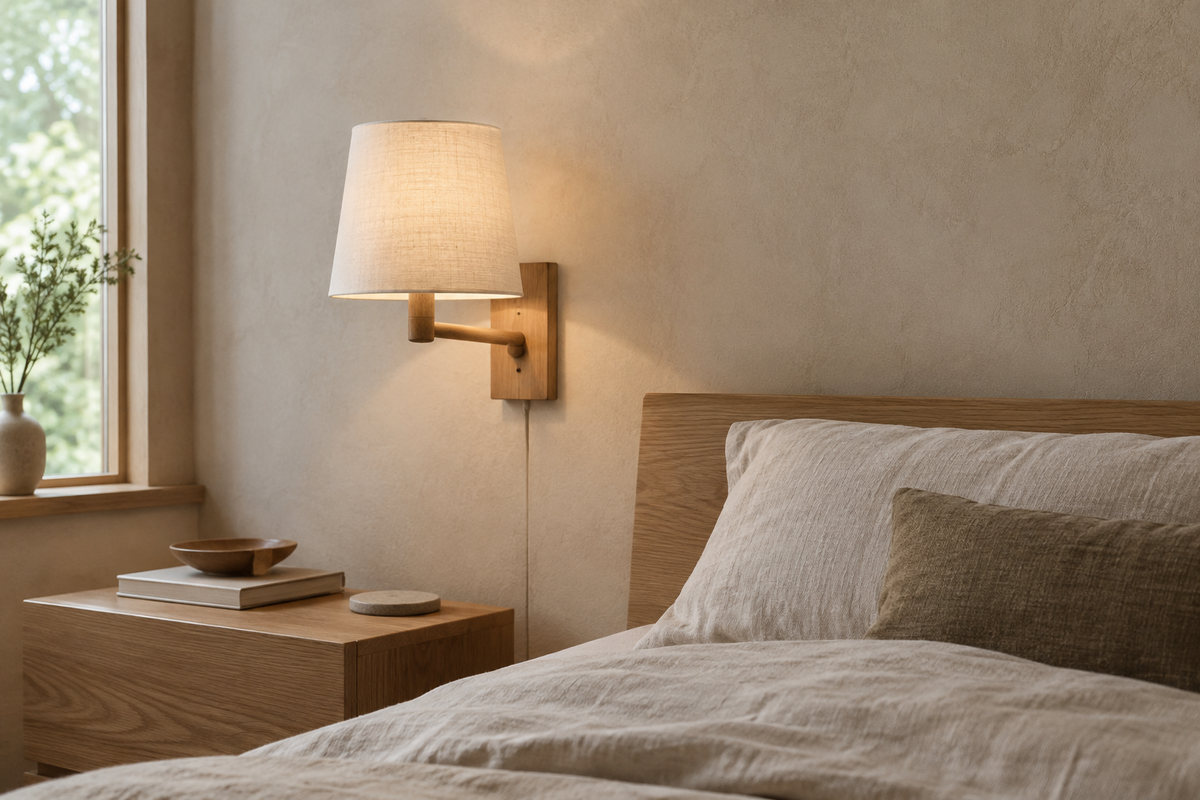
Wooden wall lamps for Scandinavian and Japandi homes typically combine simple shapes, visible wood grain, and controlled light. Compact downlights, adjustable reading arms, shaded sconces, and concealed-light panels serve different purposes, so choose the light distribution before deciding on the finish.Scandinavian interiors often favor pale timber and light-colored shades, while Japandi interiors can accommodate deeper wood tones and stronger material contrast. These are design tendencies rather than fixed rules: either approach can use light or dark wood successfully.How Scandinavian and Japandi Wall Lamps Differ Both styles emphasize useful objects, restrained forms, and natural materials. Japandi combines Japanese and Scandinavian design influences, often giving additional emphasis to texture, visual space, and the relationship between contrasting materials. Design feature Scandinavian approach Japandi approach Wood appearance Pale oak, ash, or birch tones Light timber or deeper walnut and stained finishes Fixture shape Simple cylinders, rounded shades, functional arms Restrained geometric forms, panels, and softly irregular shades Material combinations Wood with white metal, glass, or fabric Wood with paper, linen, ceramic, or dark metal Visual effect Light surfaces with limited contrast Muted surfaces with deliberate tonal contrast Use these differences to coordinate a lamp with the room rather than to classify every fixture. A pale oak sconce with a paper shade can work in either setting.Wooden Wall Lamp Styles and Their Uses Compact cylinders and block sconcesSmall cylindrical or rectangular wooden fixtures suit bedside walls, narrow alcoves, and circulation areas where a projecting shade would obstruct movement. Their simple outlines work with both Scandinavian furniture and more rectilinear Japandi interiors.Check where the light exits the fixture. A downward-facing opening produces a different result from an up-and-down design, and neither automatically provides enough usable light for reading.Adjustable wooden-arm reading lampsAn adjustable arm lets the user direct light toward a book or work surface. A wooden arm paired with a metal shade can suit a functional Scandinavian scheme, while a darker finish can relate to darker furniture in a Japandi room.Confirm the actual movement available: a pivoting shade is not the same as a fully adjustable arm. Check reach, joint clearance, and whether the lamp stays outside the normal path of movement beside the bed.Wood with paper or linen shadesA wooden bracket or backplate paired with paper or linen softens the appearance of a wall fixture. These materials can diffuse light, although the result depends on the shade's thickness, lining, and openings.This style is useful for ambient bedside or living-room lighting. For sustained reading, check whether the shade delivers sufficient light to the page without exposing a bright bulb at eye level.Indirect wooden panels and slatted sconcesIndirect sconces conceal the light source behind a wooden panel or direct it toward the wall. The illuminated surface then becomes part of the lighting effect, making these fixtures useful for background light.Slatted designs may create visible bands of light and shadow rather than an even glow. Choose a concealed panel for a quieter wall effect, or slats when a patterned result is intentional.Wood and ceramic wall lampsWood paired with a matte ceramic shade introduces a second natural-looking texture without requiring an elaborate shape. Pale wood and off-white ceramic maintain a light palette; darker timber against a muted ceramic shade creates more contrast.An opaque ceramic shade directs light through its openings rather than transmitting it through the shade body. Check those openings to understand whether the fixture functions as a downlight, uplight, or accent light.Choosing Wood Tones, Finishes, and ProportionsCoordinate the lamp with one existing timber element, such as a bed frame, shelf, or chair. An exact species match is unnecessary, but comparing undertones helps avoid an unintended clash between yellow, red, gray, and neutral finishes. For a light palette: Consider pale timber with white, cream, or light gray surroundings. For stronger contrast: Use a darker wooden fixture against a light wall and repeat that darker tone elsewhere. For visible texture: Look for grain photographs and finish details rather than relying on a color name. For material accuracy: Check whether the fixture uses solid wood, veneer, or a wood-effect surface. Matte finishes generally produce fewer visible reflections than glossy finishes. Neither a matte appearance nor visible grain proves that a lamp is solid wood, sustainably sourced, or handmade.Check the backplate size, total projection, and shade dimensions before ordering. A paper template on the wall can help you assess scale and clearance beside furniture.Choosing Light Color, Brightness, and Glare ControlFor warm residential lighting, 2700-3000 K is a useful starting range. A 2700 K source appears warmer than a 3000 K source, but color temperature does not tell you how bright a lamp will be. Brightness: Compare lumens rather than wattage, then consider how much light the shade blocks or redirects. Color rendering: A CRI of 90 or higher is a useful selection target when accurate material and fabric colors matter. Dimming: Confirm compatibility among the lamp, light source, driver, and dimmer. An LED fixture is not automatically dimmable. Glare: Favor shielding or diffusion when the light source would otherwise be visible from the bed or sofa. For reading, assess the light reaching the page rather than the brightness of the wall around it. For ambient lighting, use wall lamps alongside other light sources instead of expecting one decorative sconce to illuminate the entire room.Placement, Power, and Installation ChecksThere is no single mounting height that works for every wooden wall lamp. Position the fixture around the user's seated eye level, the furniture height, and the direction of the light, then test for glare before fixing its location.At a bedside, check that the switch is reachable and the shade clears the headboard. In a hallway, assess projection and applicable clearance requirements; a compact fixture may be more practical than a long arm.Choose the power format according to use. Hardwired fixtures require suitable wiring and installation under local rules; plug-in fixtures need an accessible outlet and managed cord routing; rechargeable fixtures need regular charging.For occasional wayfinding, a battery-powered option such as the Ultra USB Motion Sensor Rechargeable Wall Light provides an alternative to a wired fixture. Its rechargeable, motion-sensor format should not be assumed to provide sustained reading light. Follow the manufacturer's mounting instructions, light-source limits, and required clearances. Use a fixture rated for the intended environment, particularly in bathrooms or other damp locations, and keep paper or fabric shades away from unsuitable heat sources.Frequently Asked QuestionsCan wooden wall lamps work in both Scandinavian and Japandi interiors?Yes. Simple wooden fixtures can suit both styles. Coordinate the wood tone, shade material, and shape with the room rather than relying on a style label.What color temperature suits wooden wall lamps?A range of 2700-3000 K is a useful starting point for warm residential lighting. Choose brightness separately using lumen output and the fixture's light distribution.Are wooden wall lamps suitable for bedside reading?They can be, provided they direct sufficient light onto the page without glare. Adjustable arms and shielded shades offer more control than purely decorative indirect sconces.Do wooden wall lamps need hardwiring?No. Wooden wall lamps may be hardwired, plug-in, or rechargeable. Check the specific fixture's power requirements, mounting instructions, and suitability for its intended location.
How to Decorate With Wall Decor With Light
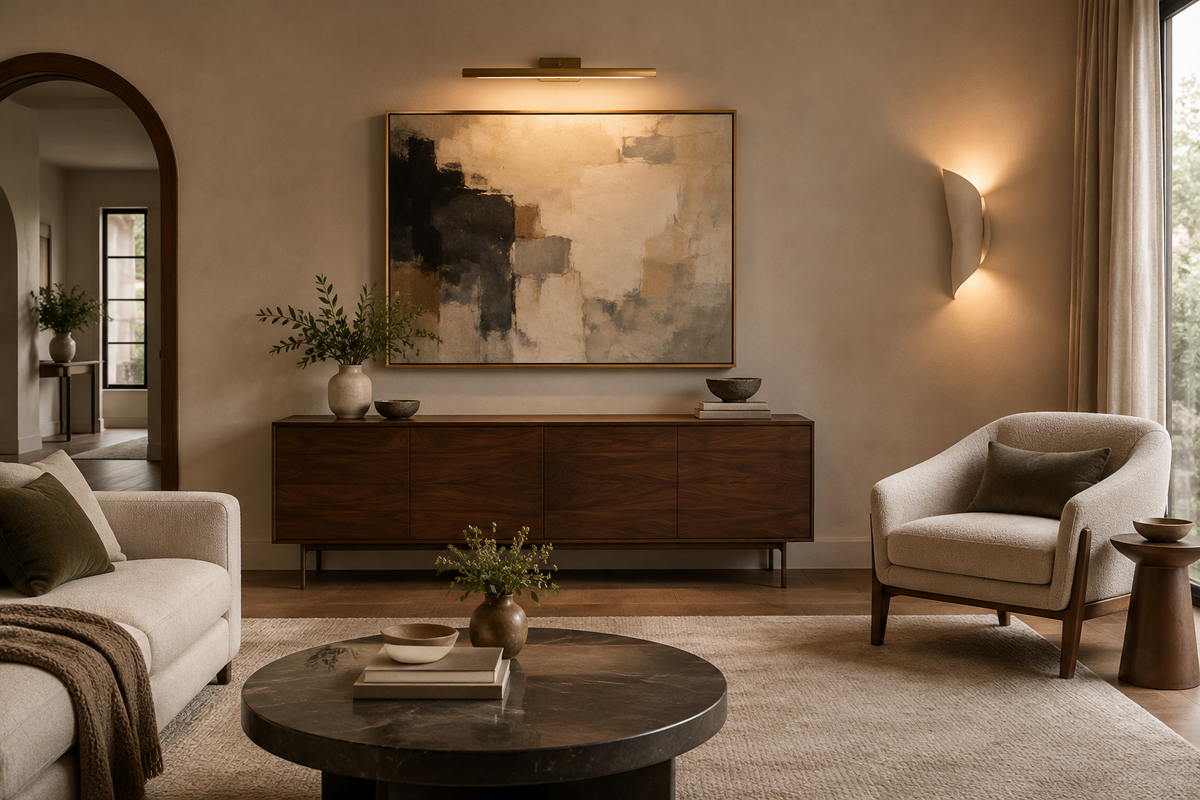
To decorate a wall with light, choose one focal point, select a fixture that either illuminates the decor or becomes part of it, and test its position before installation. Picture lights highlight artwork, sconces add light and visual structure, and concealed LEDs create a glow behind mirrors, panels, or shelves.The most important decisions are scale, light direction, brightness, and power access. Plan these together so the wall looks balanced during the day and remains comfortable to view after dark.1. Choose the Right Type of Decorative Wall Lighting Start by deciding whether you want to illuminate an object, reveal a wall surface, or display a decorative light fixture. These goals require different beam patterns and mounting positions. Lighting type Useful application What to check Picture light Illuminating a framed painting or print Coverage across the artwork and reflections on glazing Wall sconce Framing artwork, a mirror, or furniture Shade direction, fixture projection, and visible bulb glare Concealed LED strip Backlighting a panel or mirror, or lighting beneath a shelf Concealment, diffusion, ventilation, and access to the power supply Lighted wall art or LED sign Making the illuminated object the focal point Brightness control, mounting requirements, and cord placement String lights Creating a lightweight outline or informal wall arrangement Approved mounting methods and the product's permitted uses Use a picture light when the artwork should remain the main attraction. Choose a sculptural sconce when the fixture itself should contribute to the composition, or concealed lighting when you want the light effect without a visible lamp.2. Plan the Wall Composition and ScaleIdentify the main object before adding lights: a painting, mirror, shelf arrangement, or illuminated sculpture. Center the overall composition on the furniture or architectural feature it relates to, rather than automatically centering everything on the entire wall.For art above furniture, a common starting guideline is an arrangement about two-thirds of the furniture's width. This is a design heuristic, not a requirement; include flanking sconces in the overall visual width when they form part of the arrangement. Measure the wall, nearby furniture, artwork, and proposed fixtures. Mark the artwork and fixture outlines with removable painter's tape suitable for the wall finish. Check the composition from the doorway and the main seating position. Leave enough space around frames for fixtures, light spread, and maintenance access. Symmetrical sconces can frame a centered artwork or mirror. An asymmetrical arrangement can work when it follows a clear relationship, such as one sconce beside a reading chair and a larger artwork above the adjacent console.3. Position Lights to Control Glare and Shadows Fixture height depends on what the light needs to illuminate and where people will see it. A universal mounting height cannot account for different ceilings, furniture, fixture shapes, and seated sightlines.For framed artworkCenter a picture light over the artwork and follow the fixture manufacturer's positioning guidance. Test the beam across the entire image, checking for a bright upper edge, a dark lower section, and reflections in glass or glossy finishes.If a reflection blocks the image, adjust the fixture's distance, angle, or position where the design allows. Check from both standing and seated positions before drilling.For mirrors and textured wallsBacklighting a mirror creates a halo but usually does not provide sufficient face lighting by itself. If the mirror is used for grooming, add suitable front-facing illumination rather than relying only on the decorative glow.Light aimed close along a wall surface emphasizes texture, including uneven plaster and installation defects. A broader wash generally produces a more even appearance, while a grazing beam is useful when deliberately highlighting brick, stone, or relief artwork.For sconces near furnitureKeep exposed light sources out of normal sightlines wherever possible. Beside a bed or chair, test the position while seated or reclining and confirm that switches are accessible and fixtures do not interfere with movement.4. Choose Light Color, Brightness, and ControlsFor a warm residential appearance, 2700K to 3000K is a common starting range. Around 3500K to 4000K produces a more neutral appearance, but the result also depends on wall colors, daylight, and surrounding lamps.Use similar color temperatures for nearby fixtures that should read as one arrangement. When accurate artwork colors matter, look for a published color rendering index of 90 or higher, while recognizing that CRI does not describe every aspect of color rendering. Compare lumens, not just watts: Lumens describe light output; watts describe power consumption. Check beam spread: A narrow beam creates a concentrated accent, while a wider beam covers more wall area. Confirm dimming compatibility: The lamp, driver, and dimmer must support the intended control method. Test at night: A comfortable daytime setting may feel too bright in a dark room. Decorative wall lighting should complement the room's general and task lighting. Do not assume a glowing artwork or backlit panel can replace lighting needed for reading or circulation.5. Plan Power and Install SafelyChoose the power source before committing to the layout. Hardwired fixtures require suitable wiring and mounting provisions, while plug-in and rechargeable lights have different cable, outlet, and charging requirements. Power type Planning consideration Hardwired Confirm electrical box requirements, switching, and installation under local electrical rules. Plug-in Locate an accessible outlet and route the cord away from walkways and pinch points. Battery or rechargeable Allow access for charging or battery replacement and check runtime at the intended brightness. Use mounting hardware suitable for both the wall material and the fixture's weight. Do not assume adhesive strips can support a light unless the fixture and mounting-system instructions explicitly permit that installation. Have a qualified electrician handle new wiring or uncertain existing connections. Use fixtures rated for the location, especially in bathrooms or outdoors. Follow required clearances from curtains, paper, and other combustible materials. Keep LED drivers accessible and ventilated as specified by the manufacturer. Never staple through light cables or place ordinary flexible power cords inside walls. For valuable or light-sensitive artwork, limit exposure time and intensity and seek conservation guidance. LEDs generally produce little ultraviolet radiation, but visible light can still fade sensitive materials.Frequently Asked QuestionsWhat is the two-thirds rule for wall decor?It is a design guideline suggesting that artwork or a grouped arrangement above furniture span roughly two-thirds of the furniture's width. It is a starting point rather than a fixed rule, and flanking lights can count toward the composition's overall width.Can you decorate a wall with lights without hardwiring?Yes. Plug-in sconces, battery-powered wall lights, rechargeable fixtures, and suitable string lights can work without new hardwiring. They still require secure mounting and a plan for cords, charging, or battery access.What color temperature works for decorative wall lighting?Warm white light around 2700K to 3000K is a common choice for living rooms and bedrooms. A more neutral appearance around 3500K to 4000K may suit other settings; test it against the wall finish and nearby lighting.How do you reduce glare on illuminated wall art?Adjust the light's angle or position and check reflections from the main viewing locations. Diffusion or lower brightness can reduce harshness, but repositioning is often necessary when a light source reflects directly in glazing.
Modern Wall Lights for Hallways, Stairs, and Entries: A Buying Guide
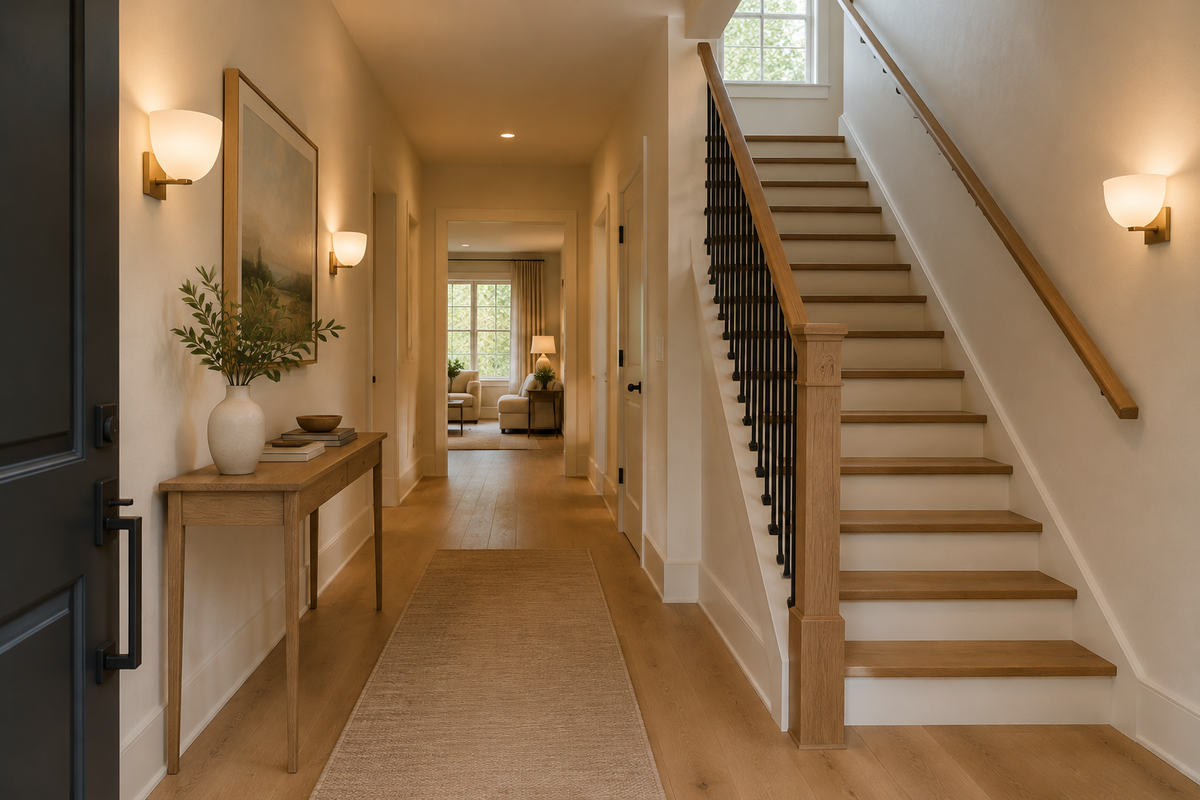
Modern wall lights for hallways, stairs, and entries should illuminate the walking route without exposing people to distracting glare. Shallow diffused sconces suit narrow corridors, shielded step lights help reveal stair treads, and wall lights with broad light distribution can supplement entryway lighting.Choose the light pattern and power source before selecting the finish. Fixture projection, mounting position, usable light output, and controls determine whether a wall light works in a circulation space.Compare Modern Wall Light Types Modern wall lights differ in how they distribute light, not just in appearance. Use the fixture's light pattern to decide whether it can support general illumination, highlight a surface, or guide movement. Fixture type Useful application Main buying consideration Shallow diffused sconce Narrow hallways and entry passages A covered light source reduces direct glare; check the total projection from the wall. Up-and-down sconce Hallways and entry walls Light beams emphasize the wall but may leave the floor insufficiently lit. Indirect wall sconce Ambient hallway or foyer lighting Output depends partly on the reflectance of the wall or ceiling receiving the light. Shielded step light Stair flights and changes in level The beam should reach tread surfaces without exposing a bright source to approaching users. Adjustable wall light Entry consoles or specific objects Projecting arms need clearance and should not obstruct the walking route. A fixture mounted close to the wall is not necessarily recessed. Surface-mounted sconces sit on the wall, while recessed step lights require suitable space within the wall and an installation method compatible with its construction.Plan Placement for Hallways, Stairs, and Entries Hallways: prioritize clearance and continuous illuminationMeasure the corridor at its narrowest point and check each fixture's full projection, including its shade and arm. Where accessibility or egress rules apply, confirm permitted projections and clearances before purchasing.For conventional sconces, a center height around 60-66 inches above the finished floor can serve as an initial design reference, not a universal requirement. Adjust for fixture dimensions, eye-level glare, ceiling height, and the manufacturer's instructions.Set spacing according to light distribution rather than a fixed interval. A long corridor needs overlapping illumination without dark gaps at doors, corners, or changes in level; existing ceiling lights may provide part of that coverage.Stairs: illuminate treads and landingsStair lighting should make tread edges, landings, and changes in direction visible from both ends of the flight. Check sightlines while ascending and descending, because a concealed source from one direction may be exposed from the other.Low-level step lights can follow the stair slope, while higher sconces can supplement ambient illumination. Neither arrangement automatically replaces required stairway lighting or controls; have the layout checked against applicable local requirements.Entries: account for doors, mirrors, and furniturePlace entryway wall lights outside door swings and away from positions where coats or furniture could cover them. When lighting a console or mirror, check that the source does not produce a harsh reflection at normal standing height.A larger foyer may need ceiling lighting in addition to sconces. For exterior entries or covered porches, select fixtures specifically listed for the damp or wet conditions at the installation location.Choose Hardwired, Plug-In, or Rechargeable PowerHardwired wall lightsHardwired sconces suit permanent lighting layouts and can work with wall switches, compatible dimmers, or occupancy controls. Installation depends on suitable wiring, electrical boxes, fixture ratings, and local requirements, so use a qualified electrician where required.Plug-in wall lightsPlug-in sconces can reduce the need for new fixed wiring when a suitable outlet is nearby. Keep cords away from stair treads, door openings, and walking routes, and check mounting requirements before treating a fixture as a rental-friendly option.Rechargeable wall lightsRechargeable lights provide supplementary illumination where wiring is impractical, but their availability depends on battery charge. Check runtime at the intended brightness, charging access, mounting security, and whether activation is manual or sensor-controlled.The Ultra USB Motion Sensor Rechargeable Wall Light is a wireless, battery-powered option described for areas including hallways and stairs. Treat this type of light as supplemental guidance unless its specifications and the installation satisfy all applicable requirements for primary lighting. Check Brightness, Color Temperature, and GlareCompare lumens rather than watts when assessing light output: lumens describe the amount of light emitted, while watts describe electrical power consumption. Total lumens alone do not show how much light will reach a stair tread or the floor beneath a sconce. Choose a useful beam pattern. Diffusers distribute light broadly; shielded optics direct it toward specific surfaces. Use warm white deliberately. A 2700-3000 K color temperature is a common residential choice; keep adjacent fixtures consistent unless a contrast is intentional. Check color rendering. A CRI of 90 or higher is useful when accurate appearance of wall colors, artwork, or wood finishes matters. Inspect the light source from multiple positions. Frosted covers and shielding can reduce direct glare, but fixture position still matters. Confirm dimming compatibility. The LED lamp or integrated driver must work with the selected dimmer or control system. Dark paint and low-reflectance finishes can reduce the contribution of indirect lighting. In those spaces, prioritize light reaching the walking surface rather than relying entirely on reflected wall or ceiling light.Verify These Details Before BuyingCompare fixtures using their technical specifications rather than styled photographs alone. If a listing omits a detail that affects installation or safety, obtain confirmation before ordering. Dimensions: check height, width, projection, backplate size, and clearance from doors and handrails. Electrical compatibility: confirm supply voltage, wiring method, and suitable safety certification for the installation market. Light source: establish whether the fixture uses replaceable bulbs or an integrated LED module, and check service options. Controls: verify dimming, sensor coverage, activation delay, and manual override where relevant. Location rating: distinguish indoor dry-location use from damp- or wet-location suitability. Maintenance: consider access for cleaning, bulb replacement, battery charging, or driver servicing. Before committing to multiple fixtures, mark their outlines on the wall at full size. Check the proposed positions with doors open and from both directions of travel, then confirm the lighting layout before electrical work begins.Frequently Asked QuestionsWhat type of wall light works in a narrow hallway?A shallow sconce with a diffused or shielded light source can illuminate a narrow hallway while limiting projection and direct glare. Confirm that the fixture preserves required clearances and provides enough light on the walking route.How high should hallway wall sconces be mounted?A center height around 60-66 inches above the finished floor is a common starting point for conventional hallway sconces. The final position depends on fixture size, glare, ceiling height, manufacturer instructions, and applicable requirements.Can rechargeable wall lights replace hardwired stair lighting?Rechargeable wall lights should generally be treated as supplementary stair lighting because their operation depends on battery charge. Do not use them to replace required lighting unless the complete installation satisfies applicable local requirements.Can indoor wall lights be used at an exterior entry?Only use a fixture outdoors if its listing permits the conditions at that location. A covered entry may require a damp-location fixture, while exposure to rain generally requires a wet-location fixture.

How to Use Living Room Decor Lights Without Overlighting
Use living room decor lights without overlighting by giving each fixture a purpose, keeping ambient light adjustable, and adding brightness only where an activity needs it. Shield visible bulbs, check reflections from seated positions, and switch off lights that duplicate another fixture's job.The goal is not to make every corner equally bright. It is to provide enough light for movement and activities while keeping decorative accents from competing with one another.Recognize overlighting before adding another lampOverlighting means providing more illumination than a space or activity needs. Glare is a related but different problem: a visible bulb or strong reflection can cause discomfort even when the room overall is dim. Excessive overall brightness: The room feels unnecessarily bright for conversation or television viewing, with several fixtures illuminating the same area. Direct glare: A bulb or exposed LED is uncomfortable to look toward from the sofa or armchair. Reflected glare: Lamps appear in the television, glass artwork, or glossy furniture. Too many competing accents: Several illuminated objects draw attention at once, leaving no clear visual focus. Assess the room after dark with your usual lights switched on. Turn fixtures off individually: if visibility remains adequate and comfort improves, that fixture may not need to operate in that setting.Give each light a specific job Ambient, task, and accent lighting describe functions, not fixed fixture types. A floor lamp can provide ambient light when directed toward a wall or task light when aimed at a book. Lighting role Purpose How to avoid excess Ambient Provides general visibility for movement and conversation. Use diffused or reflected light, then adjust output to the room's needs. Task Illuminates reading, crafts, or another specific activity. Direct light onto the activity rather than raising brightness throughout the room. Accent Draws attention to artwork, shelving, or an architectural feature. Choose a limited number of focal points and keep spill light controlled. Build these layers only where needed; having three lighting roles does not require three fixtures to remain on. A reading lamp and a modest ambient source may be sufficient when one person is using the room.A portable, adjustable lamp can provide a localized decorative glow without increasing ceiling-light output. For example, the Moon Cordless LED Dimmable Table Lamp provides adjustable ambient light; treat it as a supplementary source rather than assuming it can illuminate a reading task. Choose light output and color temperature separatelyLumens measure a lamp's total light output; watts measure its electrical power consumption. Compare lumens when choosing brightness, because lamps with similar wattage can produce different amounts of light.There is no single lumen total that prevents overlighting in every living room. Room dimensions, ceiling height, shade design, surface colors, and fixture placement all affect how much light reaches useful surfaces.Adjust brightness at the activityIf a book is difficult to read, first adjust the reading lamp's position or output rather than brightening the entire room. Keep some surrounding illumination so the page is not a bright island in an otherwise dark space.Use a consistent starting color temperatureFor evening ambient and decorative lighting, 2700K to 3000K is a common warm-white starting range. Color temperature describes the appearance of white light, not its brightness, so a warm lamp can still be too bright.Keeping nearby lamps at similar color temperatures reduces obvious differences in their appearance. Adjust for the room's finishes and your visual needs rather than treating one Kelvin value as mandatory.Position fixtures to prevent glare and reflections Check lighting from the seats people actually use, not only while standing in the doorway. A fixture that looks comfortable from above may expose its bulb at seated eye level. Beside a sofa or armchair: Position the shade so it conceals the bulb from the usual seated position while allowing light to reach the activity. Near the television: Move lamps that appear in the screen, and avoid directing light onto it. Check reflections with the screen dark. On shelving: Conceal LED strips behind a lip or use a suitable diffusing channel so individual emitters are not directly visible. At a wall or ceiling: Use reflected light to spread illumination, but check that the lit surface does not become an uncomfortable bright patch. Near mirrors or glass: Change the fixture's angle or position if its reflection is visible from a main seat. A shade or diffuser can soften the appearance of a source, but it does not guarantee comfortable brightness. Dark walls also reflect less light than pale walls, so improving placement may help more than adding another decorative fixture.Use separate controls instead of running every light togetherSeparate switching lets you change lighting by activity without making the entire room brighter. If dimming is needed, confirm that both the light source and its control support compatible dimming; not every LED works with every dimmer.For plug-in lamps, follow the lamp and control manufacturers' compatibility requirements. Have hardwired controls installed according to local electrical requirements by a qualified electrician. Conversation: Use diffused ambient light and selected decorative accents, leaving unused task lights off. Reading: Increase the reading light while retaining enough ambient illumination for comfortable surroundings. Television: Reduce ambient output, eliminate screen reflections, and switch off distracting accents. Cleaning: Use higher general illumination temporarily to make surfaces and obstacles easier to see. Balance the room with a final nighttime checkAfter positioning the fixtures, adjust the room with curtains and blinds in their usual evening positions. Start with the minimum useful lighting and add only what improves visibility or supports a deliberate focal point. Set ambient light so people can move around furniture and see one another. Switch on task lighting only at occupied activity areas. Add accent lighting to the feature you want to emphasize. Sit in each main seat and check visible bulbs, screen reflections, and bright surfaces. Dim or switch off redundant fixtures, then confirm that circulation routes remain visible. If the room still feels uncomfortable, identify whether the cause is excessive output, glare, or poor distribution before buying more lights. Repositioning one lamp or changing a shade can address a problem that additional fixtures would worsen.Frequently asked questionsHow many lamps should a living room have?There is no fixed number. Use enough fixtures to support circulation, occupied activities, and selected accents without unnecessary overlap; room layout and light distribution matter more than lamp count.Can a living room be lit without overhead lighting?Yes. Floor lamps, table lamps, and wall lights can provide ambient and task lighting if their output and placement give adequate visibility throughout the areas people use.Does warm light prevent overlighting?No. Warm light describes color temperature, not brightness. Prevent overlighting by controlling output, distribution, glare, and how many fixtures operate at once.Why does a dim living room still have glare?A small, bright source can create glare against dark surroundings. Shield or reposition the source and provide modest surrounding illumination rather than relying only on reducing total room brightness.

Holiday Season Bestsellers: The Home Decor & Lighting People Buy From October to December
What home decor sells from October to December? Cordless lamps, string lights, cozy textiles, glass candle holders and giftable decor. See the picks in our Holiday Season Bestsellers collection.

Gifts to Yourself This Holiday Season: 16 Cozy Home Upgrades Worth Buying for You
Treat yourself this holiday season: 16 cozy home upgrades, from cordless lamps to sheepskin throws, with starting prices from $22 to $89.

Holiday Gifts Under $100 and Up to $250: Statement Lighting & Decor Presents
A holiday gift guide for bigger presents: cordless lamps, wall sconces, vases and pendant lights from $57 to $243, sorted by budget.

Holiday Gifts Under $50: 18 Home Decor & Lighting Ideas
18 holiday gift ideas under $50 from Letifly: string lights, glassware, cushion covers, candle holders and more from $13, sorted by budget.

How to Choose Wall Lights for a Small Room
Wall lights work well in small rooms because they add light without using floor or table space. The right choice depends on three practical factors: what the light needs to do, how far it projects from the wall, and how bright it feels once installed.If you are deciding between decorative and functional options, start with function first. In a small room, a wall light should either replace a lamp, support a task such as reading, or add soft ambient light without making the room feel crowded.Start With the Light's JobBefore comparing styles, decide whether the wall light is meant for ambient, task, or accent lighting. This single step helps narrow down size, brightness, beam direction, and placement. Ambient lighting: fills the room with general light. Task lighting: supports reading, dressing, or bedside use. Accent lighting: highlights art, texture, or architectural details. In a small bedroom, task lighting near the bed often matters more than a large decorative fixture. In a narrow entry or hallway corner, soft ambient lighting usually works better than a focused beam.Choose a Fixture Shape That Saves Space Small rooms benefit from wall lights with a shallow profile. A fixture that stays close to the wall reduces visual clutter and lowers the chance of bumping into it in tight walkways.Look for forms such as slim sconces, flush wall lamps, or compact directional lights. If you need flexible placement without hardwiring, a rechargeable option such as the Ultra USB Motion Sensor Rechargeable Wall light can help in closets, bedside areas, and narrow circulation zones where simple installation matters.Good shape choices for small rooms Upward-facing sconces when you want softer bounce light Adjustable bedside sconces for reading Low-profile wall lights for tight passages Rechargeable wall lights where wiring is impractical Match Brightness to Room SizeA small room does not need a large fixture, but it still needs enough usable light. Brightness should match the function of the light and the amount of other lighting already in the room.For ambient lighting, aim for a soft, even effect rather than a harsh point source. For reading or bedside use, choose a wall light that directs illumination where needed and avoids spill directly into the eyes. Use Best Light Effect What to Avoid Bedside reading Focused, directional light Wide glare at eye level General ambient light Diffused or bounced light Overly bright exposed bulbs Hallway or corner Soft spread with low projection Large shades that stick out Closet or storage area Compact practical light Fixtures that require complex wiring If the room already has ceiling lighting, wall lights can be less powerful and more targeted. If the wall light is doing most of the work, choose a design that spreads light broadly enough to prevent dark corners.Use Placement to Make the Room Feel Larger Placement affects how spacious a room feels. In small rooms, wall lights usually work best when they define a useful zone, such as each side of a bed, a mirror edge, or a seating corner.Symmetrical placement can make a compact room feel more ordered. Installing matching lights on both sides of a focal point often creates balance and frees up surfaces that table lamps would otherwise occupy.For a broader lighting reference point, browsing modern design lighting examples can help compare projection, shade shape, and overall scale before choosing a final type.Basic placement guidelines Keep the fixture proportional to the wall section, not just the room Use pairs where symmetry improves balance Center bedside fixtures to the sleeping position, not only the furniture Check sightlines from the doorway to avoid visual crowding Pay Attention to Shade, Glare, and Light DirectionIn a small room, glare is more noticeable because you are closer to the light source. Shades, diffusers, and indirect beam angles often feel more comfortable than bare bulbs.Choose upward, shaded, or diffused light when you want the room to feel calm and open. Choose adjustable directional light when the goal is reading or task use. If you need flexible secondary lighting on nearby furniture, a cordless option like the Moon Cordless LED Dimmable Table Lamp can supplement a wall light without taking a permanent installation approach; it is rechargeable and designed for adjustable ambient light with 8 to 10 hours of continuous use.Pick a Finish and Style That Keep the Room Visually LightBecause small rooms show every object more prominently, the finish of a wall light matters. Clean lines, restrained detailing, and a finish that relates to other hardware in the room usually look more cohesive than an oversized statement piece.If the room is already busy with patterns, storage, or artwork, a simpler wall light often works better. If the room is minimal, a sculptural fixture can add character as long as its scale stays controlled.Common Mistakes to Avoid Choosing a fixture that projects too far into the room Using exposed bulbs that create direct glare Installing lights too high or too low for the intended task Relying on one wall light for all lighting needs in a multi-use room Picking a decorative shape first and checking function later The best wall light for a small room is usually compact, purposeful, and visually quiet. It should improve how the room works while helping it feel more open, not more crowded.FAQWhat type of wall light is best for a small room?Low-profile sconces, shaded wall lamps, and adjustable reading lights are usually the most practical choices. The best type depends on whether you need ambient, task, or accent lighting.Where should wall lights be placed in a small bedroom?They are commonly placed at each side of the bed for reading and surface-space savings. Placement should align with how the bed is used and should avoid direct glare into the eyes.Are wall lights better than table lamps in a small room?They can be, especially when surface space is limited. Wall lights free up bedside tables, desks, and narrow walkways.How bright should wall lights be in a small room?Bright enough to support the intended use, but not so strong that the room feels harsh. Diffused light works well for ambient use, while focused light is better for reading or task areas.

Warm Lighting for Bedroom: Best Fixtures and Bulbs
Warm bedroom lighting works best when it combines a soft color temperature, low glare, and multiple light sources. For most bedrooms, the most useful range is 2700K to 3000K because it feels comfortable at night while still giving enough visibility for reading, dressing, and general use.The right setup usually includes one ambient fixture, one or two task lights, and an optional accent light. This layered approach makes the room feel calm without relying on a single bright ceiling light.What warm light means in a bedroomWarm light refers to bulbs with a lower color temperature, usually measured in Kelvin. In bedrooms, warm white light generally falls between 2700K and 3000K, while very amber light can be even lower.This range helps reduce the sharp, bluish feel that often makes bedrooms look flat or overly bright. If you want a restful atmosphere, start with warm white and add dimming before choosing decorative fixtures.Best bulb color temperature for bedroom lightingFor most bedrooms, 2700K is the safest all-purpose choice. It gives a soft, residential look that works well for overhead fixtures, bedside lamps, and wall lights.3000K is slightly cleaner and brighter in appearance. It can work well in bedrooms that need clearer task lighting, but it still feels warmer than neutral white light. Bulb temperature How it looks Best use in a bedroom 2200K-2400K Amber, very soft Accent lighting, evening mood lighting 2700K Warm white Main bedroom lighting, bedside lamps, sconces 3000K Soft white Reading lights, dressing areas, layered ambient light If you use LEDs, choose dimmable bulbs when possible. Dimming matters as much as color temperature because even a warm bulb can feel harsh at full brightness.Best fixtures for warm bedroom lighting The best fixture depends on what the light needs to do. A bedroom usually feels most balanced when each fixture has a clear role instead of trying to make one ceiling light do everything.Bedside table lampsTable lamps are one of the easiest ways to add warm light at eye level. They create a softer glow than overhead fixtures and make the bed area feel more settled in the evening.A portable lamp can also help in rooms where outlets are limited. A cordless dimmable table lamp is especially useful when you want flexible placement on a nightstand, shelf, or dresser. The Moon Cordless LED Table Lamp is designed for adjustable ambient light and rechargeable use, which makes it suitable for this kind of layered bedroom setup.Wall lights and sconcesWall lights work well when you want to free up nightstand space or place light closer to the bed for reading. They also help distribute light more evenly across the room than table lamps alone.For subtle nighttime illumination, a low-output wall light can reduce glare and improve visibility near closets, hallways, or the bed. A rechargeable wall light can be practical for bedrooms because it is wireless and intended for spaces including bedrooms and closets.Pendant lightsPendant lights can work in bedrooms when they are used as a decorative ambient source or as a bedside alternative to table lamps. The key is to avoid exposed glare and choose shades that soften or direct the light downward.If you want a statement fixture with a gentler look, materials and shade shape matter as much as the bulb. A pleated pendant light can help diffuse light visually, and the Pleated Ceramic & Brass Cocoon Pendant Light is described as a design that blends form and function.Ceiling fixtures for general lightEvery bedroom needs one dependable ambient source, whether that is a flush mount, semi-flush mount, or pendant. This fixture should provide broad coverage without becoming the only layer of light in the room.If you are starting from scratch, browsing a broader lighting collection can help you compare shapes and fixture types that support layered lighting rather than a single harsh overhead source.How to layer warm lighting in a bedroom A simple three-layer plan works in most bedrooms: Ambient light: ceiling fixture or pendant for overall visibility Task light: bedside lamp or wall light for reading and focused use Accent light: soft decorative lamp or low-level night lighting for atmosphere This arrangement lets you change the room based on time of day. In the morning, you can use ambient and task lighting together. At night, you can rely mostly on lamps and accent light to keep the room softer.How to choose bulbs that feel warm, not dimWarm lighting should still be functional. A common mistake is choosing a very low Kelvin bulb but not enough brightness, which makes the room look dull rather than comfortable.Look at brightness separately from color temperature. In practical terms, choose warm LEDs with enough output for the fixture's job, then use dimmers or multiple lamps to control intensity. Use lower brightness for accent lighting Use moderate brightness for bedside reading Use the highest brightness in the main ambient fixture, but keep it dimmable Also pay attention to shade material, bulb visibility, and fixture height. Frosted bulbs, fabric or ceramic shades, and indirect light all help reduce glare.Common bedroom lighting mistakes Using only one overhead light Choosing bulbs above 3500K for evening use Using exposed bulbs near eye level Skipping dimmers or adjustable light levels Adding decorative fixtures without enough task lighting Most of these problems are easy to fix with layering and bulb replacement. You do not always need a full redesign to make a bedroom feel warmer.How to build a warm bedroom lighting setupIf you want the simplest approach, start with one warm overhead fixture at 2700K or 3000K, then add bedside lighting on both sides of the bed if space allows. After that, add one accent source such as a small lamp or low-level wall light.This creates a room that can shift between practical and restful use without looking overly bright. The goal is not just warmer bulbs, but a lighting plan that puts soft light where you actually need it.FAQWhat is the best warm light bulb for a bedroom?For most bedrooms, a 2700K LED bulb is the best general choice. It looks warm without becoming too amber and works well for ceiling lights, lamps, and sconces.Is 3000K too bright for a bedroom?3000K is usually not too bright by itself. It is a slightly cleaner white than 2700K, and whether it feels too bright depends more on bulb output, glare, and dimming than the Kelvin rating alone.Are warm LEDs good for bedroom lighting?Yes. Warm LEDs are energy efficient, long lasting, and widely available in dimmable versions, which makes them practical for layered bedroom lighting.What fixtures work best for a warm bedroom?The most effective combination is usually a ceiling fixture for ambient light, bedside lamps or wall lights for task lighting, and one low-level accent light for evening use.

Room Ceiling Light Ideas for Low, Medium, and High Ceilings
Choosing a ceiling light starts with one practical question: how much vertical space does the room have? Ceiling height affects safety, visual balance, brightness, and how widely light spreads. A fixture that works well in an 8-foot room can feel undersized in a room with a vaulted or double-height ceiling.The simplest way to decide is to match the fixture profile to the ceiling height. Low ceilings usually need close-to-ceiling fixtures, medium ceilings can handle more shape and drop, and high ceilings benefit from larger fixtures or multiple light sources that bring light down into the room.How ceiling height changes your lighting optionsCeiling lights do two jobs at once: they provide ambient light and they take up visual space. In lower rooms, a fixture that hangs too far down can interrupt sightlines and circulation. In taller rooms, a fixture that sits too close to the ceiling may leave the room feeling dim at eye level and visually empty overhead.Before choosing a style, measure the floor-to-ceiling height and note where people walk under the fixture. Also consider room size, furniture layout, and whether the light needs to cover the whole room or mainly support task and accent lighting. Ceiling height Best fixture direction Common choices Low Keep the fixture tight to the ceiling Flush mount, semi-flush mount, recessed lighting Medium Add modest depth and spread Semi-flush mount, small chandelier, pendant High Bring light downward and fill vertical space Large pendant, chandelier, multi-pendant grouping Best ceiling light ideas for low ceilings Low ceilings generally benefit from fixtures with minimal drop. The goal is to keep head clearance comfortable while still providing even ambient light across the room. This is why flush mounts, slim semi-flush fixtures, and recessed lighting are the usual starting points.If the room feels flat, use the ceiling light as the ambient layer and add light elsewhere in the room. A rechargeable wall light can help brighten darker edges without requiring a hanging fixture in the center of the room, such as the Ultra USB Motion Sensor Rechargeable Wall light listed in the store file.What works best in low rooms Flush mount lights: Best for bedrooms, hallways, entryways, and smaller living areas where every inch matters. Semi-flush mounts: Useful when you want more shape than a flush mount but still need a compact profile. Recessed lighting: Good for clean, even coverage, especially in kitchens and multipurpose rooms. Layered wall and table lighting: Helps reduce shadows when the ceiling fixture is necessarily compact. For low ceilings, choose wider fixtures rather than taller ones when you need more presence. A broader fixture can distribute light across the room without hanging low.Best ceiling light ideas for medium-height ceilingsMedium-height ceilings are the most flexible. They usually allow enough clearance for a semi-flush fixture, a modest chandelier, or a pendant with a controlled drop. The right choice depends on whether you want the light to disappear into the room or become a visible design feature.In dining rooms, kitchens, and bedrooms, a pendant can define a zone and direct light more precisely. The store file lists a Soft Pastel Pendant Light with multiple sizes and a dimmable option, described as suitable for dining rooms and kitchens. That kind of fixture works best when there is enough ceiling height to let the form show without obstructing movement below.Good uses for medium-height rooms Semi-flush fixtures: A practical choice for living rooms, bedrooms, and home offices. Single pendants: Effective over dining tables, kitchen islands, and reading corners. Small chandeliers: Suitable where you want a decorative focal point without the scale required for a high ceiling. If you are unsure between flush and pendant styles, consider where people stand and walk. Over a table or island, a hanging light can work well because the surface below naturally preserves clearance.Best ceiling light ideas for high ceilings High ceilings need fixtures with enough scale to visually connect the ceiling plane to the occupied part of the room. A small flush mount often leaves the light source too distant, which can make the room feel underlit even if the bulb output is strong. Larger pendants, chandeliers, and grouped lights are better at bringing light down and filling vertical space.Shape matters as much as size. A pendant with visual weight, texture, or a layered shade can help a tall room feel more proportionate. The store file lists the Pleated Ceramic & Brass Cocoon Pendant Light, and notes that pendant cords can be lengthened or shortened for customization. Adjustable drop is especially useful in high-ceiling rooms where fixture height needs to be tuned to the room and furniture below.What works best in tall spaces Large pendants: Good for bedrooms, stair landings, breakfast areas, and sitting rooms with strong vertical volume. Chandeliers: Best when the room needs a central focal point and broad ambient spread. Multi-pendant groupings: Useful in stairwells, double-height entries, and open-plan spaces. Layered lighting: Pair the ceiling light with sconces, floor lamps, or table lamps so the room is bright at multiple levels. For very tall ceilings, think beyond a single overhead source. Layered lighting improves comfort, reduces contrast, and makes large rooms feel more usable at eye level.How to match ceiling lights to each roomCeiling height is the first filter, but room function should make the final decision. Different rooms need different light distribution, glare control, and fixture placement. Living room: Use a central ambient light, then add task and accent lighting around seating. Bedroom: Keep the ceiling fixture soft and diffuse, especially in low or medium-height rooms. Dining room: Pendants and chandeliers work best when centered over the table. Kitchen: Combine ceiling lighting with direct task lighting over work surfaces. Hallway or entry: Prioritize clearance and even brightness over decorative drop. When you need flexible, non-hardwired support lighting, a cordless lamp can help fill darker corners or balance a room where the ceiling fixture is intentionally subtle. The Moon Cordless LED Dimmable Table Lamp is described in the store file as a rechargeable ambient lamp for indoor and outdoor spaces with adjustable light and 8 to 10 hours of runtime.Common ceiling light mistakes to avoid Choosing a hanging fixture that is too low for the room's circulation path. Using a small fixture in a large or tall room, which can make the light feel visually lost. Relying on one ceiling light alone in rooms that need layered lighting. Picking an opaque shade when the room already struggles with brightness. Ignoring dimming, which is often the simplest way to make one fixture more versatile. Most lighting problems come from mismatch rather than style. When the fixture scale, drop, and light spread fit the room height, the result usually feels more balanced and functional.How to choose the right ceiling light quickly Measure the ceiling height. Identify whether the fixture will hang in a walkway or over furniture. Decide if the room needs broad ambient light, focused task light, or both. Choose a fixture profile: flush for low ceilings, semi-flush or pendant for medium ceilings, and larger hanging fixtures for high ceilings. Add wall, table, or floor lighting if the room needs more depth or softer evening light. If you want to compare decorative options by type, the store file identifies Design Lighting as the main lighting collection for modern fixtures. Use ceiling height first, then room function, and only then narrow the style.FAQWhat type of ceiling light is best for a low ceiling?Flush mount and compact semi-flush fixtures are usually best because they keep the light close to the ceiling and preserve head clearance.What type of ceiling light is best for a high ceiling?Large pendants, chandeliers, and multi-pendant groupings usually work best because they bring light lower into the room and better match the room's vertical scale.Are pendant lights good for medium-height ceilings?Yes. Pendant lights work well in medium-height rooms when they are placed over tables, islands, or other zones where the drop does not interfere with movement.Do high ceilings need brighter bulbs?Often yes, but brightness alone is not enough. High ceilings also benefit from fixtures that direct light downward and from layered lighting at eye level.
